AI and Taylor Swift
— an essay in yellow, green, and violet —habla horem
AI and text — fiction and journalism, that’s the real flashpoint. AI is supposed to detect what AI wrote. Whoever gets caught can expect the end of their career. In journalism, people issue statements of honor, everything handwritten. In fiction, plenty of writers are probably sitting there right now, rewriting their AI-assisted passages so they don’t look AI-assisted — even though they’re good. And that’s the annoying part: Claude and Chat can write pretty well by now, a bit flowery and roundabout, but hard to tell apart from bad human writing, because humans can write badly too.
The Atlantic ran a piece on Jamir Nazir, whose novel came under AI suspicion. His novel, sold as a raw memoir of his village, his bakery, his own life, fell under suspicion because the sentences themselves gave him away: images too neatly placed, „smiled like sunrise over a sink,“ too polished for memory, too much like an answer to a brief. Whether a human or a machine wrote it turned out to be unprovable either way. That’s the real shock: it stays a matter of belief.
In journalism it has already become a matter of existence. Stephan-Andreas Casdorff, longtime — now former — editor-in-chief and publisher of the Tagesspiegel, let an AI write opinion pieces and was relieved of his editorial duties. The paper dutifully explained afterward that AI could be a tool, but must never take over „journalistic judgment,“ „weighing of information,“ „analytical framing,“ or „linguistic craft.“ Sounds clean, until you ask where that’s supposed to lead. Moritz Rinke walked through this in the FAZ, with a goldfish anecdote as the punchline: Stefan Aust asks ChatGPT whether goldfish make a pond clearer, gets „no,“ pushes back, gets „yes“ — both delivered with the same conviction.
„I only use AI for research,“ everyone says, the way people say they only have one glass of wine when the doctor asks.
bambla ô falli
So what’s the actual problem here? Okay, jobs, training, the future of art — IT people are already nervous about their careers, so are lawyers and tax accountants. But the real litmus test is how far AI could reach into culture, the territory we associate with consciousness, with soul, with feeling. Our home run.
blago bung
Sebastian Smee recently wrote in The Atlantic about Duchamp, currently the subject of a big retrospective at MoMA, the inventor of the readymade, whose invention coincided almost exactly with Dadaism, whose New York offshoot he shaped alongside Picabia and Man Ray. Dada texts barely look human-made — they look like a language machine with a corrupted hard drive got hold of them. Duchamp elevated everyday objects to art, long before soup-can graphics hung in dorm rooms. Big deal back then, not worth a raised eyebrow today.
Is that art? Yes! I think it’s brilliant, and yes, it’s basically the essence of what art is. But that’s a different subject.
Speaking of craft: the Dadaists in Zurich, with whom Duchamp was connected at the same time, if from New York, went one step further than he did. Hugo Ball performed his sound poem „Karawane“ at the Cabaret Voltaire in 1916, wearing a stiff, homemade cardboard costume that barely let him move. No grammar, no rhyme, no meaning, pure sound. Craftsmanship in the narrow sense — at first glance, there isn’t any. It’s essentially as random as a machine spitting out syllables would be. And yet that evening counts as one of the founding moments of literary modernism. It’s not the syllables themselves — it’s that a man stood there in the middle of the First World War, in a time when language was being burned up for propaganda and war rhetoric, and publicly destroyed that very language. The rupture was the statement, not the sound.
My real subject is music, and I’m not going to wade into whether Dylan sold his soul when he picked up an electric guitar.
I’ve been thinking about getting a drum machine and a small synthesizer. I like looping: I play a short sequence, it repeats automatically while I play something else on top. That’s how I stack sound on sound — or rather, my Boss RS-300 looper does.
Back in the Mike Oldfield days, you needed a multitrack machine like a Revox A77 for that, and the Beatles, together with George Martin, turned it into an art form with Sgt. Pepper. Probably one of the best albums ever made.
But look at it another way. Techno is largely machine-driven, or at least machines carry a huge share of the beat. In techno, effect is the goal — what the music does to me, how I start to feel the rhythm, start moving, start dancing. That’s genuinely great. → external effect
Or take rap, in all its forms. The line between music and spoken word, barely recognizable as singing anymore, fully dissolved into rhythm. In rap, someone tells their own story, the way a storyteller would in a caravanserai. Our fascination with stories is as old as humanity itself. What matters is that it’s their own story, that they actually lived it. → self-revelation
And Taylor Swift. She got married. But past all the tabloid noise, she’s one of the most remarkable artists of our time. She invented something that had existed for a long time already, just not quite like this. The Süddeutsche Zeitung ran a major feature on her two years ago. What’s genuinely interesting about that piece? It reads, for long stretches, almost like a music theory lesson: her favorite chord progression is I–V–vi–IV, the same simple cadence that already carries „Let It Be“ or „Don’t Stop Believin‘,“ known in music circles as the „Axis Progression“ because a comedy band once demonstrated how many world hits run on the same four chords. On top of that, a recurring melodic figure, the so-called „T-Drop,“ that keeps making the same small leap. All of it, in other words, musically well-worn and long since mined. Formulas you could explain in ten minutes.
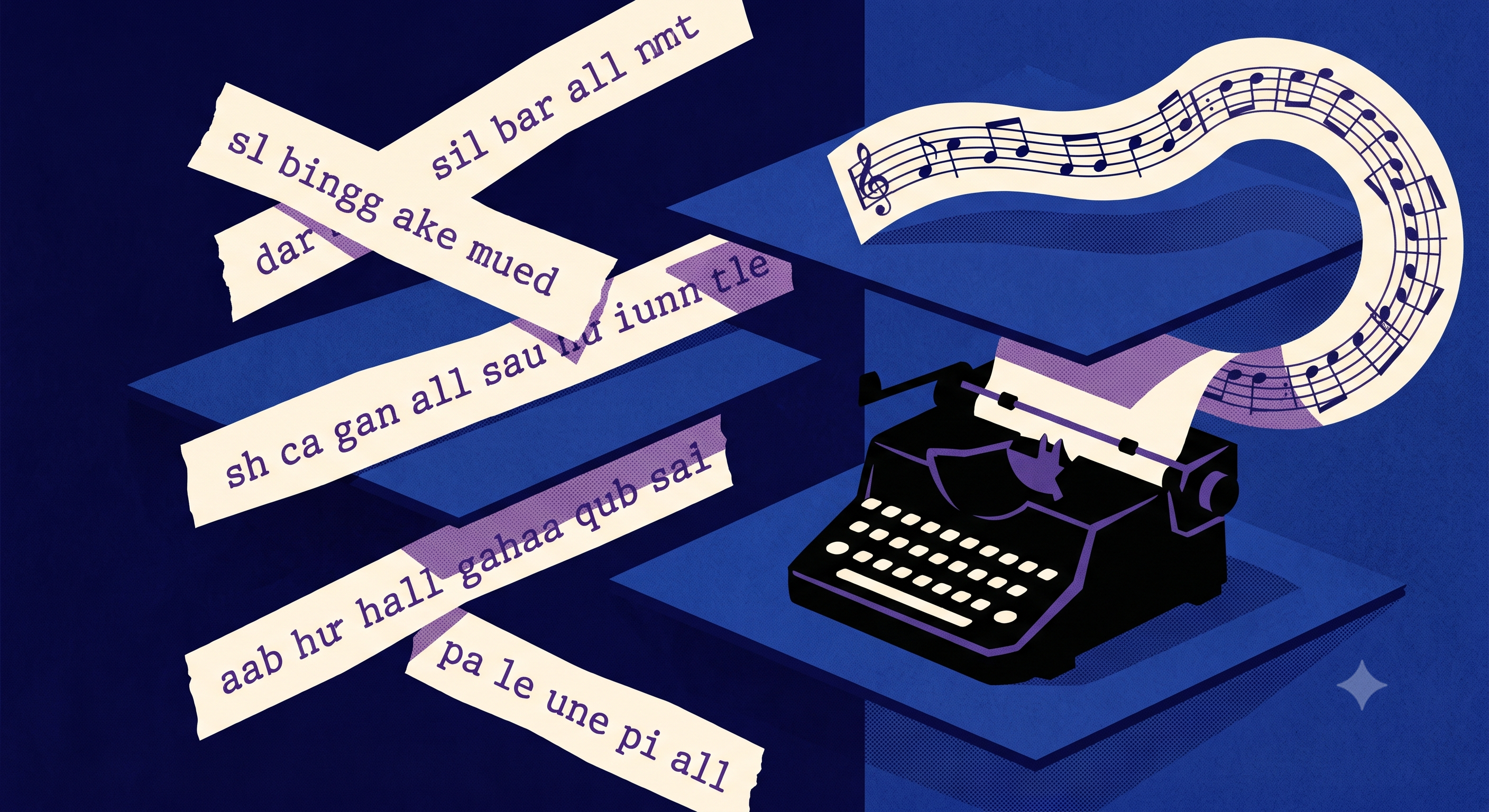
And then she undercuts the whole debate herself, long before anyone else started having it. In the title track of her album „The Tortured Poets Department,“ she describes how her lover left his typewriter at her place, and quietly wonders who even uses a typewriter anymore. Then she compares the two of them, mockingly, to Dylan Thomas and Patti Smith, the icons of suffering, authentic, ink-and-whiskey poetry — only to undercut herself immediately: no tragic poets, just two modern idiots. Anyone who knows their own cadence formula that precisely and can still write a line that dismantles the entire myth of the suffering genius in a single aside has understood exactly what self-reference and irony can do, no lit-seminar required.
What gets credited to Swift as mastery is, at its core, the exact same thing held against AI as poverty: a kit of parts, formula, repetition. A hyper-specific detail, a typewriter, a keep-going mantra, plus a big, unspecified emotional surface anyone can throw themselves into. Musical flatpack furniture.
So why is she — and her music — so exceptional? Because behind the music stands a life that can be checked: Kanye in 2009, the Mueller trial, Scooter Braun, all of it traceable song by song. The formula gets legitimized by the bill someone actually paid. And that’s exactly what you sense, what you feel, when you listen to her music. With her, someone always ends up paying the bill, and it’s always clear who that is. An AI knows the kit of parts, the formula of the music — but it never picks up the bill, and you can hear that in the result.
hollala
A simple cadence is just an anchor, generating attention for what actually carries the song: the lyrics, drawn from her own life. Taylor sings like the rapper, out of lived experience, gets the rhythm into your feet with song after song, but still manages to get people dancing in the streets outside her wedding. → The music forges a bond between her personal story and the lived reality of everyone listening — even though the raw material, the cadence, is available to anyone, AI included. Would we dance in the streets if Claude and Chat got married?
AI can’t write from lived experience. But it can help — the way a drum machine helps me hold a rhythm, or the way Claude helped me sort the scattered thoughts that led to this piece.
And if anyone thinks they know what art and literature are supposed to be, they should take a look at the AfD’s party platform. Or how Trump handles art and culture — he did try his hand at Taylor Swift. The moment we lock art and culture into a cage that dictates what they’re allowed to be, they’re already gone. That’s how it’s always been.
AI doesn’t destroy art. AI doesn’t destroy culture. Only people who think they know what art and culture are supposed to mean can do that.
We’ll live with it.
Full stop. And Dada.Sources
- The Atlantic: Piece on the Jamir Nazir case, Commonwealth Short Story Prize 2026
- Moritz Rinke: „Why are we letting AI make us dumber?“ (translated title), F.A.Z., June 29, 2026
- Deutschlandfunk: Stephan-Andreas Casdorff, Tagesspiegel, suspended over AI use (in German)
- Sebastian Smee: „Did Marcel Duchamp Ruin Art?“, The Atlantic, August 2026
- Hugo Ball: „Karawane“ (1916), public domain
- Jakob Biazza, Marlene Knobloch, David Steinitz: „Weltherrschaft, Taylor’s Version,“ Süddeutsche Zeitung, July 5, 2024 (in German)
- Ralf Ekrowski, Bluesky post on the Taylor Swift wedding, July 4, 2026
The structure
— a proposal from Claude after a brainstorm, reshaped several times by Ralf before it became the piece above —Part 1 — AI as the conversation-killer
- Observation: „AI wrote this“ disqualifies work in fiction and journalism, but not spreadsheets or slide decks.
- Case studies, placed side by side rather than weighed against each other: the Jamir Nazir case, the Casdorff/Tagesspiegel case, Rinke’s goldfish anecdote.
Part 2 — The hinge question
- Why exactly this line? A factual text makes no claim to any inner necessity on its author’s part. Fiction, journalism, art do — rightly or not.
- No closed answer, no thesis to hold onto — the tension is left standing, the reader draws their own conclusion.
Part 3 — The musical and artistic comparison
- Techno — effect without any test of authenticity. → external effect
- Rap — self-revelation, checked externally by the scene. → self-revelation
- Taylor Swift — self-revelation plus ongoing feedback. Formula and cadence are trivial, interchangeable, copyable by anyone. What remains is the bill someone actually paid.
- Duchamp / Dada — craftsmanship was never the criterion. What counts is the rupture, the risk, the signature someone is willing to carry.
One further note specific to this English page: the German original above is Ralf’s. This English version is a full translation by Claude — every sentence here was translated, not composed. The ideas, the structure, and the voice are Ralf’s; the English wording is Claude’s.
Karawane
jolifanto bambla ô falli bambla großiga m’pfa habla horem égiga goramen higo bloiko russula huju hollaka hollala anlogo bung blago bung blago bung bosso fataka ü üü ü schampa wulla wussa ólobo hej tatta gôrem eschige zunbada wulubu ssubudu uluw ssubudu tumba ba— umf kusagauma ba — umf
Hugo Ball, „Karawane“ (1916). First performed at the Cabaret Voltaire, Zurich, wearing a self-built, cubist cardboard costume. The poem is in the public domain (Hugo Ball died in 1927 — the 70-year post-mortem copyright term expired in 1998). Text follows the first published version, without modern spelling corrections.