The news this week tells a story.
Trump is withdrawing troops from Germany because he dislikes the Chancellor’s stance.
He’s hitting a wall against Iran’s resistance in the Strait of Hormuz.
aiwan is working with Ukrainian drone specialists.[NYT vom 5-5-26]
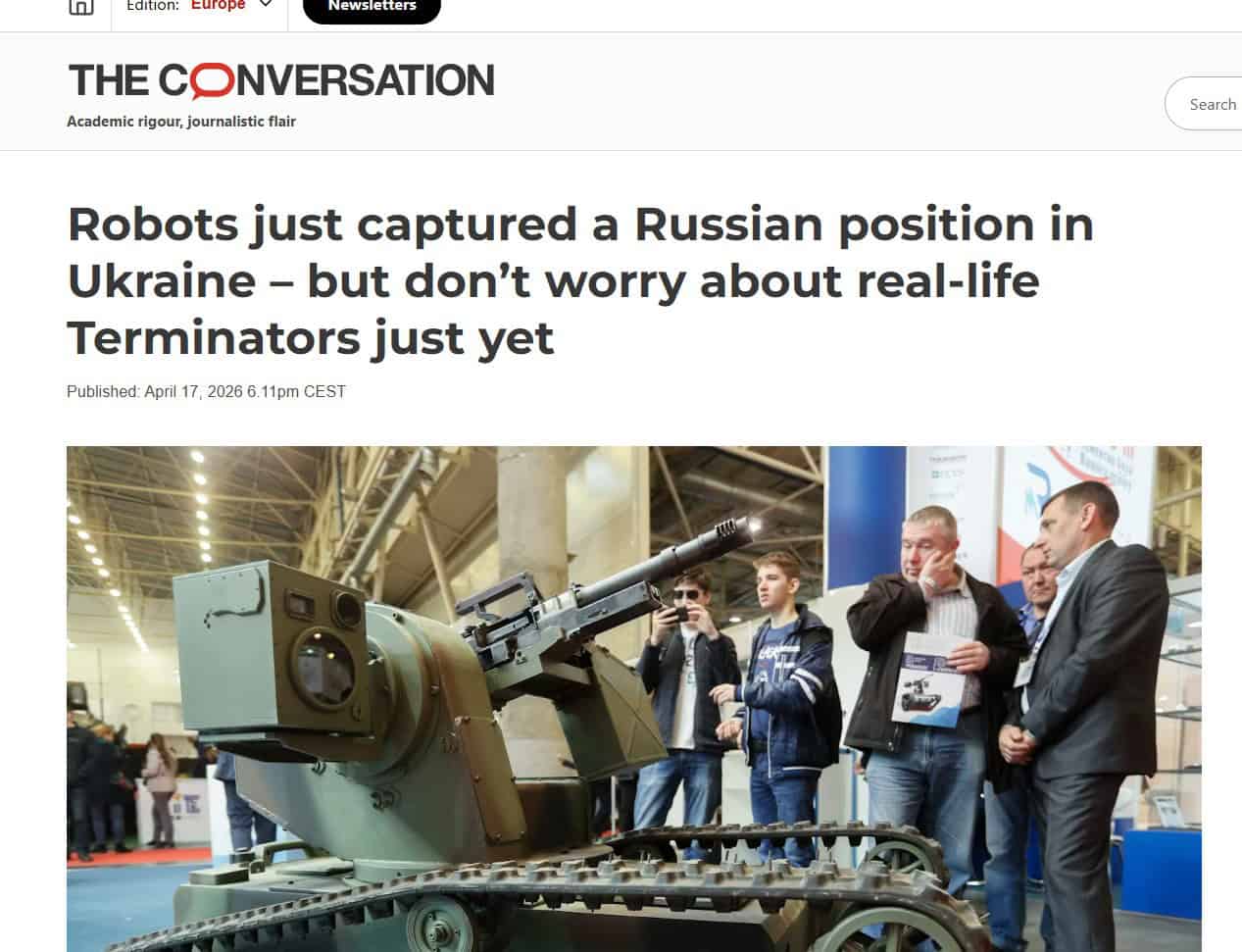
And in Ukraine, a Russian unit surrendered because robots took their position.
[The Conversation vom 04-17-2026.]
Wars have gone hybrid. Putin and Trump have brought unpredictability back to the global stage, and the world taking shape around that includes AI in all its forms: as a useful language model, as drone control, as a tool in peaceful and hostile missions alike.
AI is not a revolution. It’s an evolutionary leap, comparable to the moment humans settled down and grew grain. The same step that made civilization possible also made organized warfare possible. The underlying technology is old, but storage speed and computing power have driven it into territory that was unthinkable ten years ago.
Who is guiding us through this leap? Donald Trump.
The White House is considering requiring pre-release review of AI models, according to reporting by Tripp Mickle, Sheera Frenkel, Julian Barnes and Dustin Volz in the New York Times on May 4, 2026.
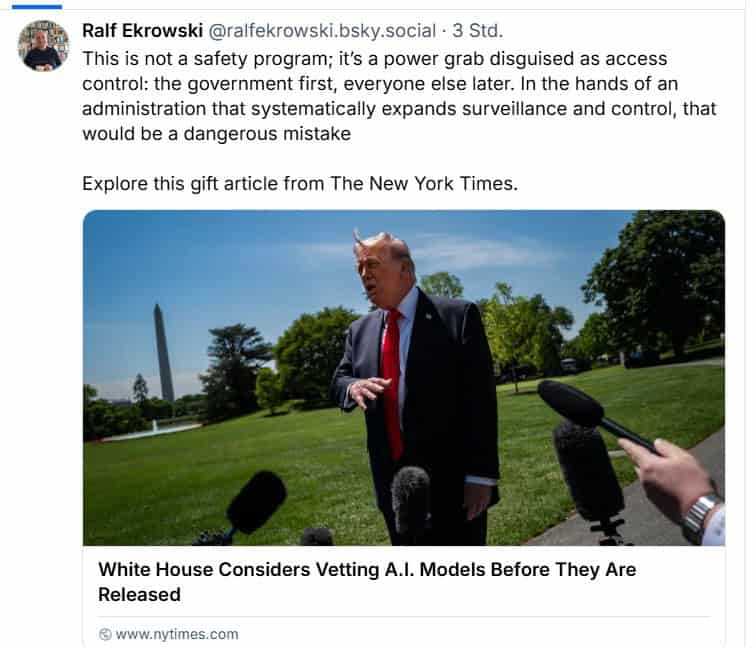
That Trump reverses course is nothing new. Staying on track was never his thing. But this reversal deserves attention: whoever wants to „control“ AI is asking to be handed the systems and their inner workings. That is not regulation. That is acquisition.
The background is known. Anthropic refused to hand over its models for military use. The Pentagon terminated the contract. Anthropic sued. Meanwhile, the NSA is reported to be using Anthropic’s cybersecurity model Mythos Preview, even as the Trump administration had otherwise pushed Anthropic out of government use. [WinFuture vom 04-21-2026]
The US under Trump has become, in parts, a surveillance state. ICE is the visible tip, but the distrust toward its own population runs deeper. In that context, AI is not a neutral tool.
AI agents in the hands of a government that systematically monitors its own citizens represent a different category of threat. Drones kill enemies.
Surveillance AI targets the population it is supposed to serve.
The EU offers a countermodel, not out of idealism, but out of principle. The Digital Services Act has shown that digital regulation works when the goal is accountability and not access: transparency obligations, liability rules, enforceable user rights. The EU AI Act follows the same logic. Bans on mass state surveillance, risk tiers, independent oversight. The aim is not control over technology as possession, but control over its effects as law.
Trump pursues the opposite. Members of his family hold stakes in AI-adjacent companies and defense firms seeking government contracts. Whoever regulates, controls. Whoever controls, profits. This is not a policy shift. It is a business model.
The difference from the EU is not semantic. It separates rule of law from kleptocracy.
The NYT report from May 5 should not be read as a technocratic policy debate. It describes who gets the keys.
KI Takeaway
AI Takeaway Trump’s reversal on AI oversight is not a safety concern. It is an acquisition play: the Pentagon and intelligence agencies want first access to the most powerful models. The EU, with the DSA and the AI Act, provides the only rights-based framework. Whoever controls AI controls more than technology.