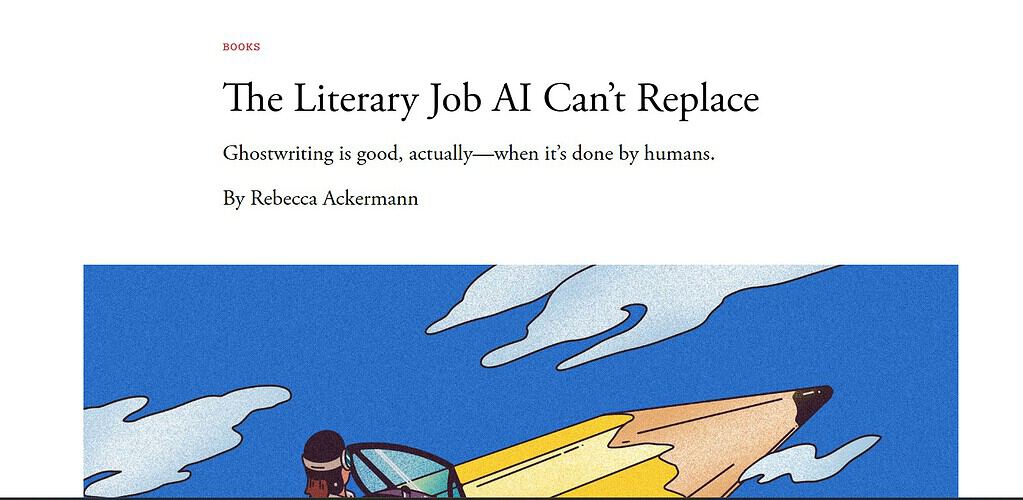
The current discourse on AI and ghostwriting—as seen recently in The Atlantic—is far too preoccupied with preserving old privileges. What we are witnessing in the realm of language is nothing short of a revolution.
We must get used to the fact that programs which treat language as pure statistics can impress us so deeply that we begin to doubt whether we are truly the only language-gifted beings. But if you shift the focus away from the „Big Picture,“ another aspect comes to light: the liberation of our thinking from the corset of expediency.
1. The End of the Literary Masquerade
We have grown accustomed to technology replacing humans, from the power loom to GPS. If we hesitate now with memoirs, it is only because we view writing as the last sacred core of being human. But let’s be honest: a celebrity book has always been a „self-marketing product“ and rarely a literary highlight. At most, it’s a hit for the bestseller lists.
When AI guarantees the readability today that a ghostwriter once laboriously manufactured, it isn’t a cultural decline; it’s a technological upgrade. No one in a cinema expects a disclaimer stating that Superman isn’t actually flying (it’s hard, but he never could…) but is actually a product of a computer. We accept the technology if the result is right.
2. AI as the „Digital Pub Conversation“
The true value of an LLM lies not in the finished text, but in the process. It is the „pub conversation with the world machine.“ In a pub, we are free: we can talk unrestrainedly, test hypotheses, and talk complete nonsense.
School beat that out of us; even the most creative thought had to be measured against orthography, which soon became more important than content. AI is the perfect partner for the creative process—the sketch on the canvas before the oil paint covers everything. It doesn’t judge. It doesn’t nag about misplaced commas, and it doesn’t evaluate us socially. It serves as a sounding board for our associations. We use the machine as a primary notepad to find our own language amidst the chaos of our memories. The AI provides the cues, but the thought remains human.
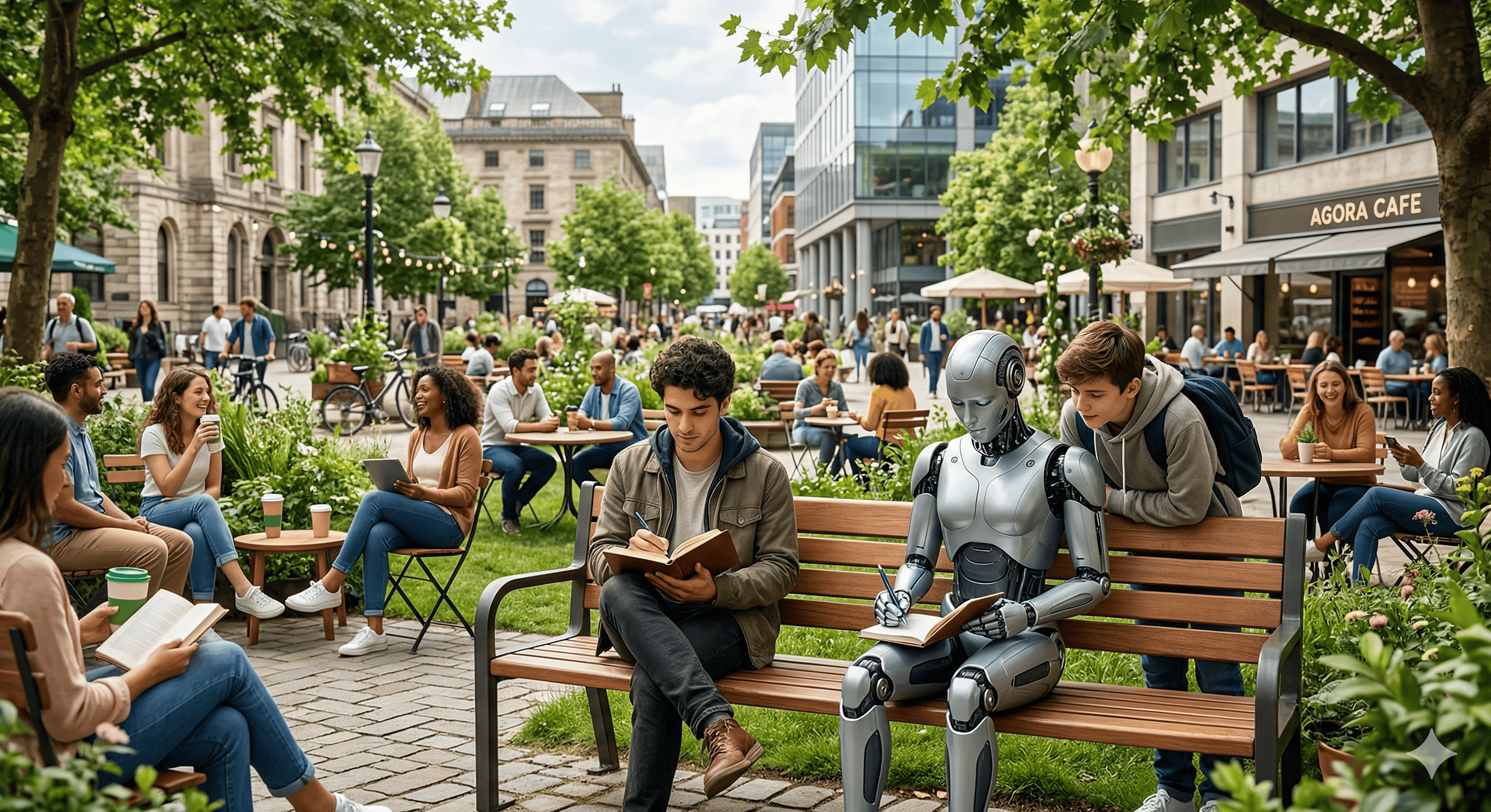
3. From the Education Factory to the New Agora
Our modern world has almost completely abolished „purposeless space.“ Education has decayed into a standardized acquisition of certificates; urban planning into the optimization of consumption, traffic flow, and cultural canons.
The classic Agora, the ancient marketplace of free exchange, has vanished. We hardly have any places left where we are allowed to „just talk“ without pursuing a goal (except perhaps the pub or the bar—the true „Third Places“). Future urban planning should, therefore, be „anti-functional.“ It should create spaces that allow exactly what we do in digital dialogue: spinning yarns and „mucking about“ without a product or a grade waiting at the end. We need to move away from the goal-orientation of every single action.
(A side note: moving from AI and ghostwriters to urban planning is a leap that only happens through open dialogue—and for that, I occasionally lack a human partner. In this case, it was the „crew at the bar“: Claude, Perplexity, and Gemini.)
4. The Masterpiece of Chance: The DaDa of the Wrong Clipboard
But back to AI and LLMs: perhaps the greatest liberation lies in the handling of the error. The funniest and most profound dialogues often arise when the technology „fails“: when you accidentally copy and paste the completely wrong content and the AI, with stoic calm, tries to make sense of it.
When a grocery list suddenly merges with a philosophical treatise, small surreal masterpieces are born that no ghostwriter would ever conceive. It is the surrender of logic to happy accident—a form of digital serendipity showing us that there is often more truth in the „error“ than in polished perfection.
The Principle of the Found Object (L’Objet Trouvé) Tristan Tzara described a recipe for writing a Dadaist poem: cut words out of a newspaper, shake them in a bag, and pull them out one by one. Perhaps the modern LLM is nothing more than a digital Cabaret Voltaire. A place where we reassemble the debris of our everyday language and realize that there is more truth in the absurd mistake than in the flawless transcript.
We are the new Dadaists, armed with algorithms to playfully deconstruct meaning. Ultimately, using AI is perhaps less a question of literary science and more a homage to Monty Python: we put on an absurd mask, feed the machine nonsense, and watch it try to explain the world with the deadpan earnestness of a Marty Feldman. It is the Ministry of Silly Texts, and that is exactly what makes us human again. The machine doesn’t see it—but we do.
5. The Value Question: What is the Perfect Copy Worth to Us?
Yet, we must also face the flip side. With the triumph of AI, a piece of human culture is being lost: editors and craftsmen of language are under massive pressure. In our fast-paced era, we must ask: What is an original worth to us?
With consumer goods, we pay more for brand-name items than for cheap imports because we value quality. But what happens when this argument fails for texts? When the machine delivers the „quality“ just as well? We accept CGI superheroes and the artificial worlds of Avatar without believing in their physical reality.
The real question is: does the „human-ness“ of a text remain worth a premium when you can no longer tell the difference visually? Are we willing to pay for the luxury of the human error and the laborious process, or is the efficient illusion enough?
Conclusion: The Privilege of Irrationality
The greatest irony of the present is that we need a highly complex calculating machine to remind us of our human irrationality. By being able to tell the AI any „nonsense,“ we break free from total expediency.
The AI may write the sentences, but the trigger—the will to narrate, the courage to contradict, and the joy of free thought—remains our property. Let us use technology not to replace thinking, but to reclaim the space for the Agora.
P.S. A Historical Side Note from the „Pub“: Interestingly, history itself provided the perfect blueprint for this tension. In 1916, at Spiegelgasse 1 in Zurich, the Dadaists founded Cabaret Voltaire to celebrate the chaotic and the absurd. Directly across the street, at Spiegelgasse 14, a man named Lenin lived, planning the ultimate, disciplined reorganization of the world.
Today, we face the same duality. We can use AI as „Lenin’s calculating machine“ to optimize our lives into a standardized factory—or we can treat it as a „Digital Cabaret Voltaire“ to rediscover our capacity for nonsense, play, and the New Agora. At this digital bar, I’ll always choose a drink with the Dadaists.
The discourse on AI and ghostwriting often clings to old privileges. Yet the true revolution lies in the liberation of thought: the LLM is the „digital pub conversation“—a space free of purpose where we shed the perfectionism of educational factories. AI doesn’t judge our spelling; it serves as a sounding board for our associations. Humans provide the trigger; the machine provides the statistics.
This liberation manifests in the „masterpiece of chance“: when a wrong clipboard entry forces surreal dialogues, Dadaism returns as an algorithm. It is the principle of L’Objet Trouvé in the data center. We use the technological peak of reason to subvert the tyranny of expediency. Monty Python and Marty Feldman send their regards: within the absurd mask, we rediscover our human voice.
This leads to a radical demand for urban planning: we need the New Agora. Places designed to be „anti-functional,“ allowing for purposeless brainstorming without the pressure of a product or a grade. When perfect AI copies devalue human craft, the „human-ness“ of a text becomes a luxury good. True sovereignty means using technology to reclaim the space for our own irrationality.